Summary
What is potassium and how does your body use it?
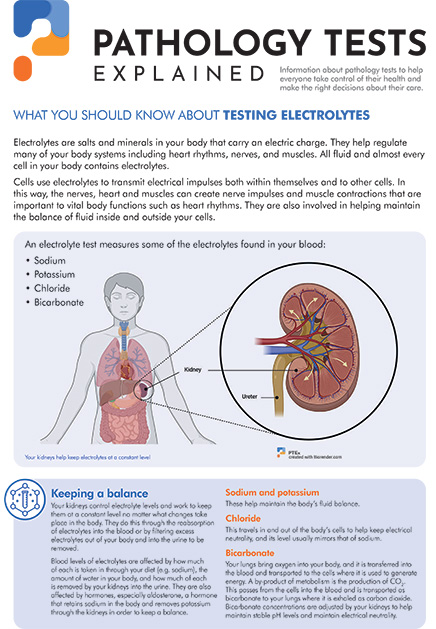
Potassium is an electrolyte. Electrolytes are minerals that carry an electrical charge in fluids. In your body, they help regulate many systems including heart rhythms, nerve impulses and muscles contractions.
Potassium is in all body fluids, but most is inside your cells with only a very small amount in your blood. Because the amount of potassium in your blood is so small, even tiny changes in levels can have a big impact on your health.
You take in potassium from the food in your diet, and excess potassium is removed by your kidneys and passed into your urine. Your kidneys maintain a consistent level of potassium by adjusting the amount kept in the blood and how much goes into the urine.
Your kidneys use sodium and potassium to help balance your body’s fluids
You have a pair of kidneys located just at the bottom of your ribcage on either side of your spine. Inside each kidney are about a million tiny blood filtering units. These filter your blood and remove wastes and excess water from your body. Water is sent to your bladder to be removed as urine.

When your kidneys filter out water from your blood, the amount of water that is kept in your bloodstream and the amount that is passed into your urine to be removed can be adjusted.
Your kidneys use sodium and potassium as a way of controlling how much water stays in your blood.
Sodium pulls water into your blood through a process called osmosis. If your kidneys hold on to more sodium, this draws more water into the bloodstream. See more on sodium.
This extra water in your blood increases the amount of blood in your circulation. Having more blood increases the pressure in your arteries and veins. More blood pushing against your blood vessel walls raises your blood pressure.

How potassium works together with sodium
In your kidneys, potassium and sodium are exchanged for each other. When potassium goes into the kidney cells, sodium is pushed out into your urine.
More potassium in your kidneys means less sodium. Less sodium means less water and lower blood pressure.
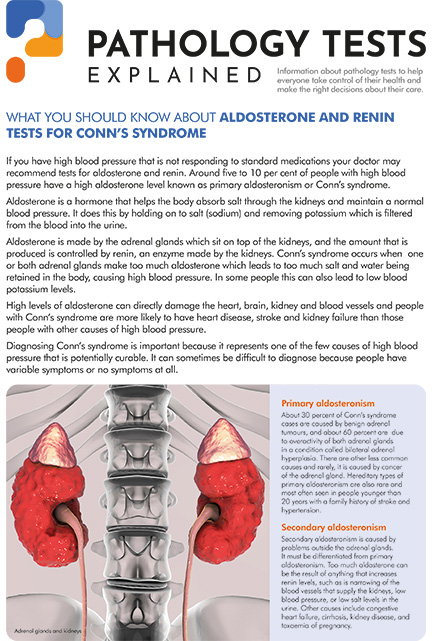
Potassium also helps relax blood vessel walls. It is part of a feedback system of hormones that control blood pressure. For more on how this works see Aldosterone and renin.
How sodium and potassium work to control your body’s fluid balance
Sodium and potassium keep the fluid levels inside and outside your cells in balance.
This:
There is a lot more sodium than potassium in the bloodstream, so sodium has a big effect on circulating blood volume and therefore blood pressure.
There is much more potassium inside cells, so potassium controls cell hydration and electrical function.

Nerve signals and muscle movement
Nerves send electrical signals so you can feel touch and pain and control your muscle movements. For example, when your brain tells your hand to pick up a cup, electricity carries the messages from your brain to your hand. This is rather like an electrical cable, except the electrical signals jump from one cell to another.
Sodium and potassium are needed to do this. They make an electrical charge through what is called the sodium-potassium pump.
This works by letting sodium and potassium move in and out of a cell in a precise sequence, creating an electrical change. Sodium and potassium in one cell create an electrical signal that jumps to the next cell, which responds by creating another electrical signal that jumps to the next cell, and so on. In this way, the nerve impulse travels along the nerve like a wave. Once the electrical impulse has passed the cell is reset ready for the next impulse.
Heart rhythm
Sodium and potassium work as electrical partners that control the heart’s rhythm and its strength of contraction.
Why get tested?
Potassium is a component of the electrolyte test, which is used for general health checks and is one of the most commonly ordered blood tests.
Electrolyte tests are most often ordered:
Having the test
Sample
Blood.
Any preparation?
None.
Your results
Causes: If you have diabetes, your potassium may fall after you take insulin, particularly if your blood glucose levels have been high for a while. Low potassium is commonly due to 'water pills' (diuretics); if you are taking these, your doctor will check your potassium level regularly. Causes: Certain drugs can also cause hyperkalaemia in a small percentage of people. Among them are:Potassium blood test results Levels What they may mean Low potassium (hypokalaemia) Potassium level below 3.5 mmol/L. High potassium (hyperkalaemia) Potassium level above 5.2 mmol/L.
Reference intervals - comparing your results to the healthy population
Your results will be compared to reference intervals (sometimes called a normal range).
If your results are flagged as high or low this does not necessarily mean that anything is wrong. It depends on your personal situation.
| Blood potassium reference intervals (These should be the same for all Australian laboratories but may differ slightly between some laboratories) | |
| Adult | 3.5- 5.2 mmol/L |
| Infants and children | 0 day to less than 1 week: 3.8 - 6.5 mmol/L 1 week - 26 weeks: 4.2 - 6.7 mmol/L 26 weeks - 2 years: 3.9 - 5.6 mmol/L 2 years - 18 years: 3.6 - 5.3 mmol/L |
| Potassium is measured as mmol/L or millimoles per litre. | |
Any more to know?
The way that your blood is taken and handled may cause the potassium level in the sample to be falsely high. If you clench and relax your fist a lot while your blood is being collected, this can make potassium rise. If blood comes out of your veins too fast or too slow, the blood cells can burst and release potassium into the blood, giving a falsely raised potassium result. Potassium can also be elevated if the specimen takes a long time to travel from your GP surgery or collection centre to the laboratory.
Several fruits, vegetables and meats are good sources of potassium. Examples include bananas, melons, oranges, potatoes, spinach, broccoli, milk, yoghurt, turkey and beef.
Questions to ask your doctor
The choice of tests your doctor makes will be based on your medical history and symptoms. It is important that you tell them everything you think might help.
You play a central role in making sure your test results are accurate. Do everything you can to make sure the information you provide is correct and follow instructions closely.
Talk to your doctor about any medications you are taking. Find out if you need to fast or stop any particular foods or supplements. These may affect your results. Ask:
More information
Pathology and diagnostic imaging reports can be added to your My Health Record. You and your healthcare provider can now access your results whenever and wherever needed.
Get further trustworthy health information and advice from healthdirect.
What is Pathology Tests Explained?
Pathology Tests Explained (PTEx) is a not-for profit group managed by a consortium of Australasian medical and scientific organisations.
With up-to-date, evidence-based information about pathology tests it is a leading trusted source for consumers.
Information is prepared and reviewed by practising pathologists and scientists and is entirely free of any commercial influence.